Earlier this month, as in most of the twenty-one Novembers I’ve been working in public schools, I was one of the teachers organizing the Remembrance Day assembly. Naturally, our grade-school MCs spoke of honour – honouring veterans and the sacrifices that so many people make in times of war.
I worked with my Grade 6 class on a sung/spoken version of Au champ d’honneur, which is a French translation of John McCrae’s fabled poem, In Flanders Fields. Because we live in the poet’s hometown, it’s practically mandatory to include this poem on Remembrance Day.
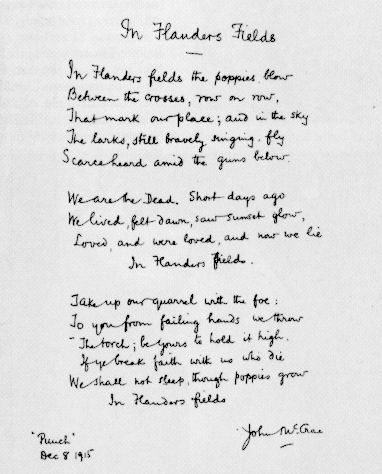
That said… I struggle with it. I struggle with the threat that goes along with the call to “take up our quarrel with the foe”. McCrae wants you to keep fighting, or be haunted forever.
As a physician, I’m sure he worked incredibly hard to keep his comrades alive. Of course he wanted all the death and horror and misery to have been worth something. He didn’t know it would be three more years and six million men’s lives (on the Allied side alone) before it was over. He would die of pneumonia and meningitis before the end.
The translation of In Flanders Fields, by French-Canadian colonel/historian/writer Jean Pariseau, captures most of the sentiments and imagery. He even got some of the rhymes.
Here’s my (non-professional) translation of the French:
Au champ d’honneur
Au champ d’honneur, les coquelicots
Sont parsemés de lot en lot
Auprès des croix; et dans l’espace
Les alouettes devenues lasses
Mêlent leurs chants au sifflement
Des obusiers.
Nous sommes morts
Nous qui songions la veille encor’
À nos parents, à nos amis,
C’est nous qui reposons ici
Au champ d’honneur.
À vous jeunes désabusés
À vous de porter l’oriflamme
Et de garder au fond de l’âme
Le goût de vivre en liberté.
Acceptez le défi, sinon
Les coquelicots se faneront
Au champ d’honneur
On the Field of Honour
On the field of honour, the poppies
Are scattered in groups
By the crosses; and in the space
The larks, grown weary,
Blend their songs with the whistling
Of howitzers.
We are dead.
We who were thinking just the night before
Of our parents, of our friends,
It is we who rest here
On the field of honour.
It’s up to you, young disillusioned ones
Up to you to carry the banner
And to keep in the depths of your soul
The taste for living in freedom.
Accept the challenge, if not
The poppies will wilt
On the field of honour
So: “On the field of honour”. I can’t help wondering whether John McCrae would have approved of that interpretation. He was grieving a close friend when he wrote his poem; he’d already seen plenty of bloodshed (not to mention squalor, disease – an overall horrific situation). I think he would have agreed with the disillusionment part, but would he have wanted to emphasize the honour? His own poem never mentions it. In fact, he focuses on simple human pleasures – the beauty of dawn and sunset, the comfort of loving and being loved.
Obviously, I know what society says: that fighting for your country is honourable, defending your country’s freedom is noble. Dying for your country is the ultimate sacrifice. Killing and maiming other humans… goes with the territory. It takes place on that same honour-soaked field.
Here’s the issue with the word honour.
When I look up “honour” on my computer’s built-in dictionary, it’s basically a tautology. Honour is esteem or respect, or an award that represents those things. If you’re honourable, you deserve the esteem or respect. But how did you earn it? The closest we get to a definition is that there is honour in doing “what is right”.
But what’s right? Dictionary.com – after informing me that it should be spelled “honor”, of course – mentions honesty, fairness, and integrity. That seems a bit more like it. But does war allow people to hold to any of those things?
It comes down to the fact that “honour” means totally different things, depending on the context. A woman’s honour was traditionally a euphemism for her chastity, but was any male person’s honour EVER measured in this way? For men, it seems that it’s more about being loyal to a specific person or code – but does that allow for honesty, fairness, or integrity?
As Sean pointed out when we were talking about this, a samurai’s honour was attached to doing his master’s bidding, whatever that might be, even unto his death – and the killing of others. In my cinematic understanding (which is admittedly not exhaustive), honour in the Mafia has to do with loyalty to the organization that organizes crime. No shortage of violence. And then there’s the soldiers, of all kinds, all over the world, honouring their military codes. Soldiers are trained to kill, because it’s “kill or be killed”, right?
Why is it considered okay to make people kill people?
It is as the Gaza Doctor, Dr. Izzeldin Abuelaish, says: “No one should be killed.” The Old Testament, applicable to Jews, Christians, and Muslims, says it too. And the Golden Rule is central to these faiths as well.

Killing is also considered a crime in almost every context. It’s not radical to agree that taking someone else’s life is bad…. Unless the government sanctions it, of course. In that case, if you dare to question the validity of military violence, you get a whole lotta vitriol.
It is monstrous and exhausting, the way we keep disregarding the basic advice that humanity has reiterated over and over, everywhere. Why has our amazing, endlessly creative, highly intelligent, compassionate species proven so abysmal at solving this problem in which we constantly fight and kill each other?
It’s only been in the last few years that I’ve understood: our global system of patriarchy does not want Peace. Only the humans do.
In the military context, I guess you have to believe that war equals honour. Otherwise you might look too closely at what war actually equals. And the patriarchy definitely doesn’t want that.
We do respect the veterans.
I think about the soldiers a lot. I think about my grandpa, getting ready to jump out of a plane over Normandy into pitch-black enemy territory, with a wife and infant son at home. Terrifying. We know he was a party to the killing – because of course he had to be. I wonder if he pondered that truth a lot after the war was over. How did it sit in his gentle soul?
When I visited Vimy Ridge, I was deeply moved – and haunted. I walked along trenches and tunnels that Canadian soldiers walked in 1917, the last place many of them sheltered before their deaths. Lots of them were teenagers. They must have been so scared, but they fought fiercely. In fact, they followed a very precise, intricate, innovative plan to take back that ridge, so total obedience to orders was everything.
As a white Canadian of European descent, I know more about WWI and WWII than other wars. But no matter where and when wars are fought, it must be true that terror is a pervasive element, everywhere and always. We are supposed to fear for our lives when we’re in danger. And I believe we are similarly wired to balk – at the very least – at killing others.
So I also want to honour the trauma of veterans. All the shell-shock, the PTSD, the grief, the injuries both obvious and invisible. The pain of being asked to hold that cognitive dissonance: we’re all human, but try hard to exterminate some of us.
It’s time to think critically about “honour” and war.
Every year I talk with my students about things like honour and peace. Honour, to them, is about helping people. Giving to the food bank, including other kids in your activities, being a good listener, lending a hand with a big job. Their ideas are sweet, kid-friendly stuff – as they should be.
When you discuss war and peace with them, it’s both crushing and heartening. Ask them to go beyond “peace means not fighting”, and they say that peace includes feeling safe, having food and shelter, being with friends and family. Recently, they are gaining conviction, because they are more aware of war now than ever. Russia and Ukraine, Palestine and Israel. They know that children – not so different from them – die every day in war. They are dying right now.
Three years ago, we had two Grade 6 students who had arrived recently from Ukraine, with family back home fighting. Their wishes for Remembrance Day were based on lived experience. One wrote, “I wish that the war in Ukraine ended and everything was fine. No people crying and children without mothers.”
She didn’t mention retaliation; it wasn’t about politics. Just make it be over.
The next year, the kids were not subtle or diplomatic when they gave their opinions about war. They all said it is horrible and wrong.
One wrote, “It is awful to watch other people die.”
Another offered, “I wish people could be shielded from harm and trauma.”
This one seemed especially unarguable: “War is not okay. People should not have to witness war, or participate in it.”
To them, it seems simple: people should stop attacking and killing other people. They see that in war, everyone loses. Even the “winners” lose; it’s incalculable pain on all sides. Come on, grownups, stop treating each other badly and find a solution.
Maybe we should decide for ourselves what honour and peace are, and live that.
I’m just really truly sick of the powers that be – the warmongers – convincing us that war is what honour looks like. Forcing humans to repress their instincts to protect and connect to each other, so that the machine of war always has fodder. Humans are agents of love; stop telling us that slaughter is just part of life. WAR IS NOT OKAY.
So, I did a little tiny subversive thing. I set Au champ d’honneur to music and just wrote a little… addendum to the poem, to make myself feel better about it. (No offense, Jean Pariseau.) It’s not much – only our little school population has heard it – and it’s perhaps a bit corny, but I needed to say it.
Et si l’honneur, à l’avenir
Et si l’honneur voulait bien dire
Donner l’amour, garder l’espoir
Soigner la paix et le savoir
Pour que les chants de nos enfants
Résonnent en joie.
And what if honour, in the future
What if honour meant
Giving love, holding to hope
Nurturing peace and knowledge
So that the songs of our children
May ring out in joy.
Now we’re heading into Peace on Earth season. My plan is to remind myself every day what peace and honour mean to me, be that agent of love, and do what I can to let my life speak.
What if we all did that?
***